
Hiring Fitness Equipment Movers? Getting It There Is Only Half the Job
Moving fitness equipment is different from moving most household belongings. If you’re searching for fitness equipment movers in Houston, one of the most important things to understand is what a company actually means when it says it can move your gym equipment.
A sofa needs to arrive without damage. A dining table needs to make it into the right room. But a treadmill, elliptical, functional trainer, Smith machine, or other piece of heavy gym equipment has another requirement: it still needs to work when the move is over.
That’s where specialized gym equipment moving becomes different from ordinary household moving.
Large fitness equipment often needs to be partially disassembled simply to clear a doorway, navigate a staircase, or safely move through a home. Once disassembly becomes necessary, moving the weight is only part of the job. Someone also needs to understand fitness equipment disassembly and reassembly, how the machine and its components should be protected during transportation, and how everything needs to go back together at the destination.
At Houston Gym Assembly, we approach fitness equipment relocation as a start-to-finish service. That means planning the disassembly, protecting the equipment and the home, moving and securing the equipment for transportation, reassembling it at the new location, and checking its operation before we consider the job complete.
Houston Gym Assembly is not a referral service or third-party marketplace. When you contact us for a fitness equipment move, you’re contacting the company that will actually handle the project. Our technicians perform the disassembly, moving, transportation and reassembly from start to finish.
Because when you’re hiring fitness equipment movers, getting the equipment to the new address is important. Getting it there is only half the job.
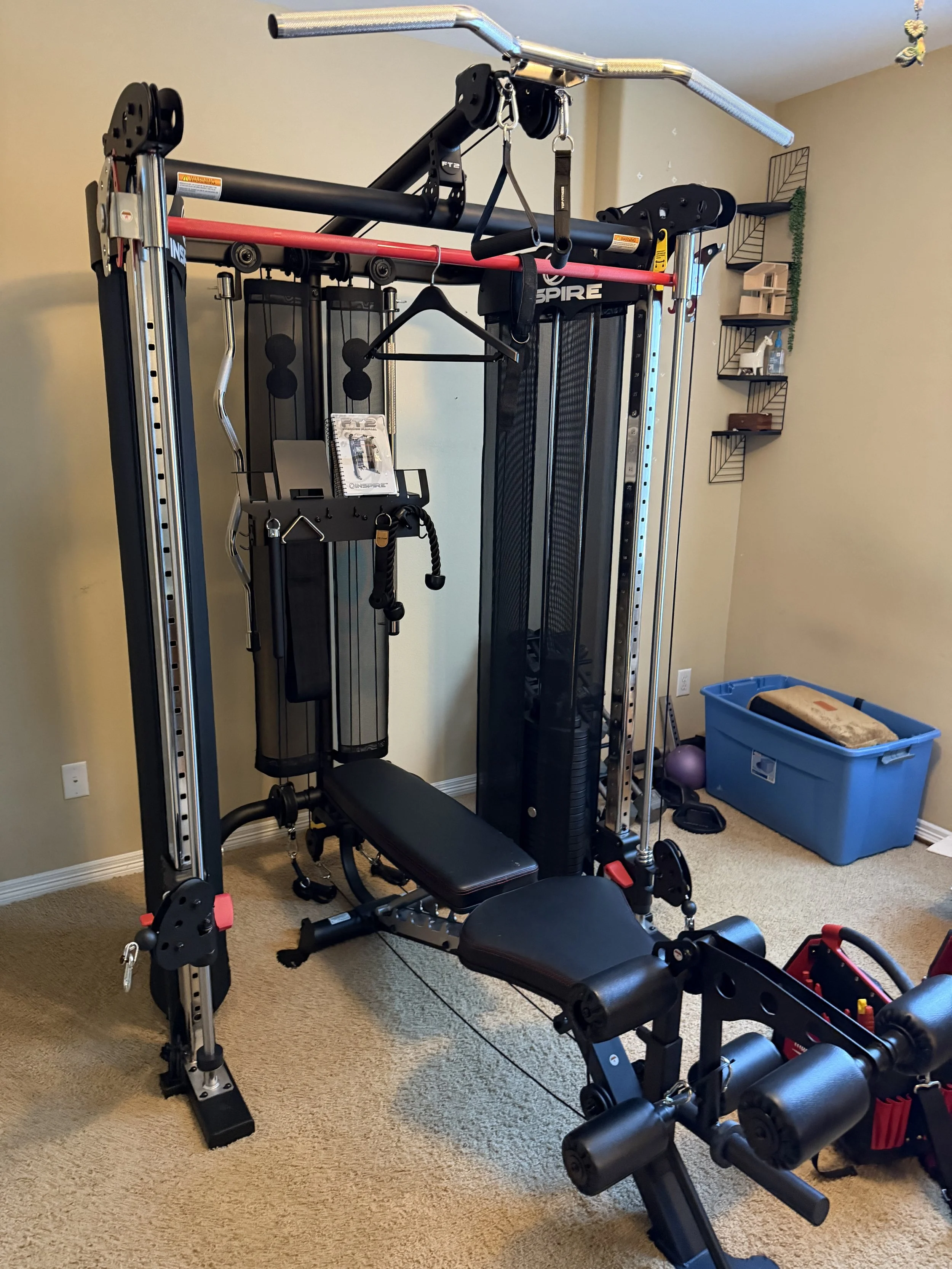
Inspire Fitness FT2 functional trainer in the customer’s upstairs home gym before our Houston Gym Assembly team began disassembly and relocation to their new home.
A Real Houston Gym Equipment Move: Relocating an Inspire FT2
A recent Inspire Fitness FT2 relocation from Katy to Houston is a great example of what a start-to-finish fitness equipment move looks like.
The homeowners were in the process of moving, but they chose to have their Inspire FT2 handled separately by Houston Gym Assembly. In fact, when we arrived at the new home, it was completely empty. The FT2 would become the first piece of their belongings moved into the house.
For equipment like this, that decision makes sense. A functional trainer such as the Inspire FT2 represents a significant investment and combines substantial weight with cables, pulleys, dual weight stacks, guide rods, a Smith bar, and numerous interconnected components. Moving it isn’t simply a matter of having enough people to lift it.
The FT2 was located in a second-floor home gym at the pickup location. Before removing anything, our fitness equipment technicians evaluated the machine and the path it would need to travel, including the staircase and turns through the home.
Our goal wasn’t to completely dismantle the machine. It was to determine the right amount of disassembly to safely move it out of the second floor, protect the equipment and the home along the way, and make reassembly at the new location as controlled as possible.
That’s one of the advantages of hiring a company that specializes in fitness equipment moving, disassembly, and reassembly. When our technicians remove a cable, pulley, frame component, or piece of hardware, we’re not just thinking about getting the machine downstairs. We’re already thinking about how everything will go back together at the destination.
Because Houston Gym Assembly handled the entire relocation, responsibility for the FT2 never changed hands. The team disassembling the machine was also responsible for moving it, transporting it from Katy to Houston, and reassembling it in the new home.
That continuity helped turn what could have been a complicated second-floor functional trainer move into a smooth relocation from start to finish.
Disassembling and Moving Heavy Gym Equipment Safely
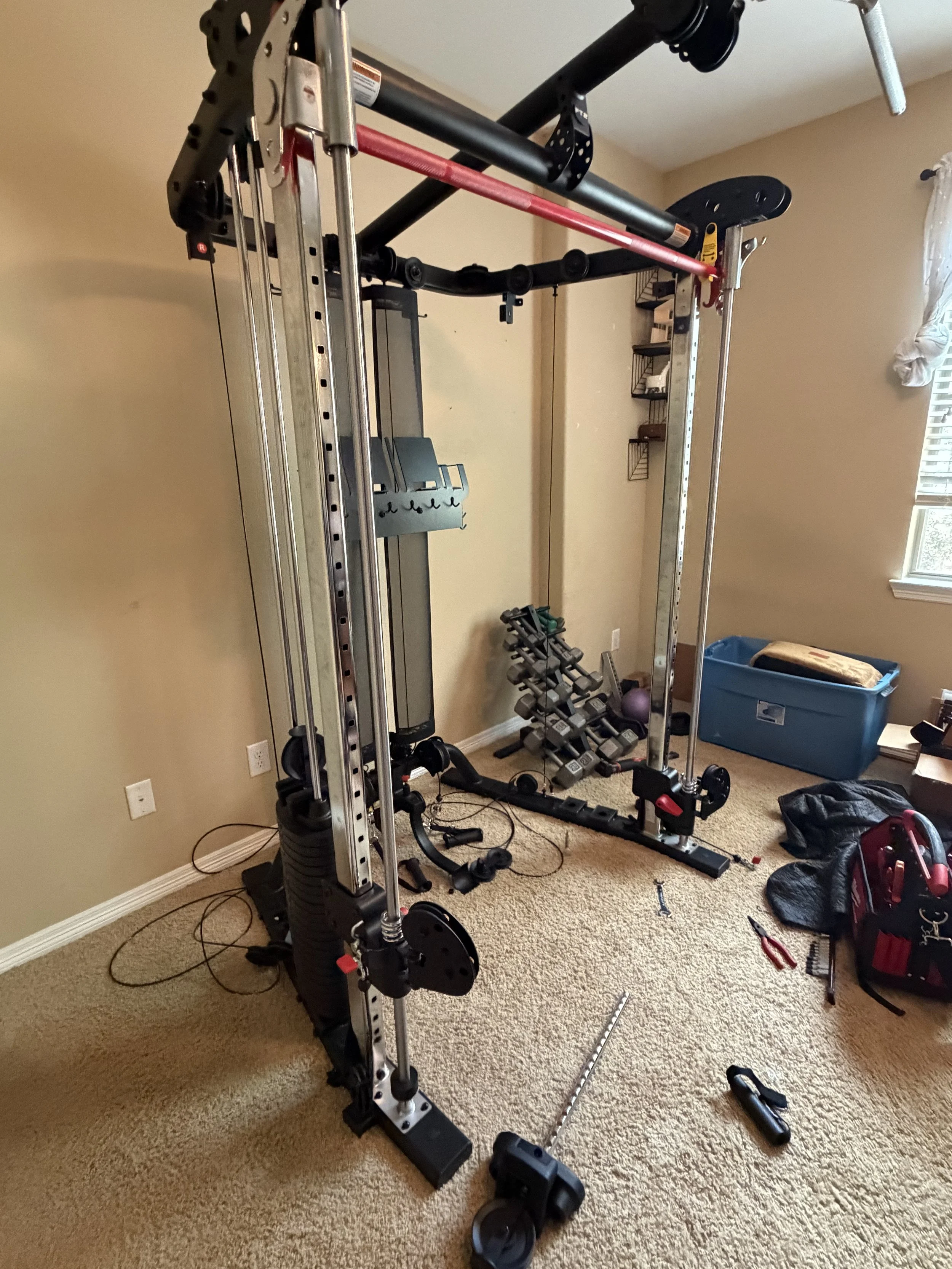
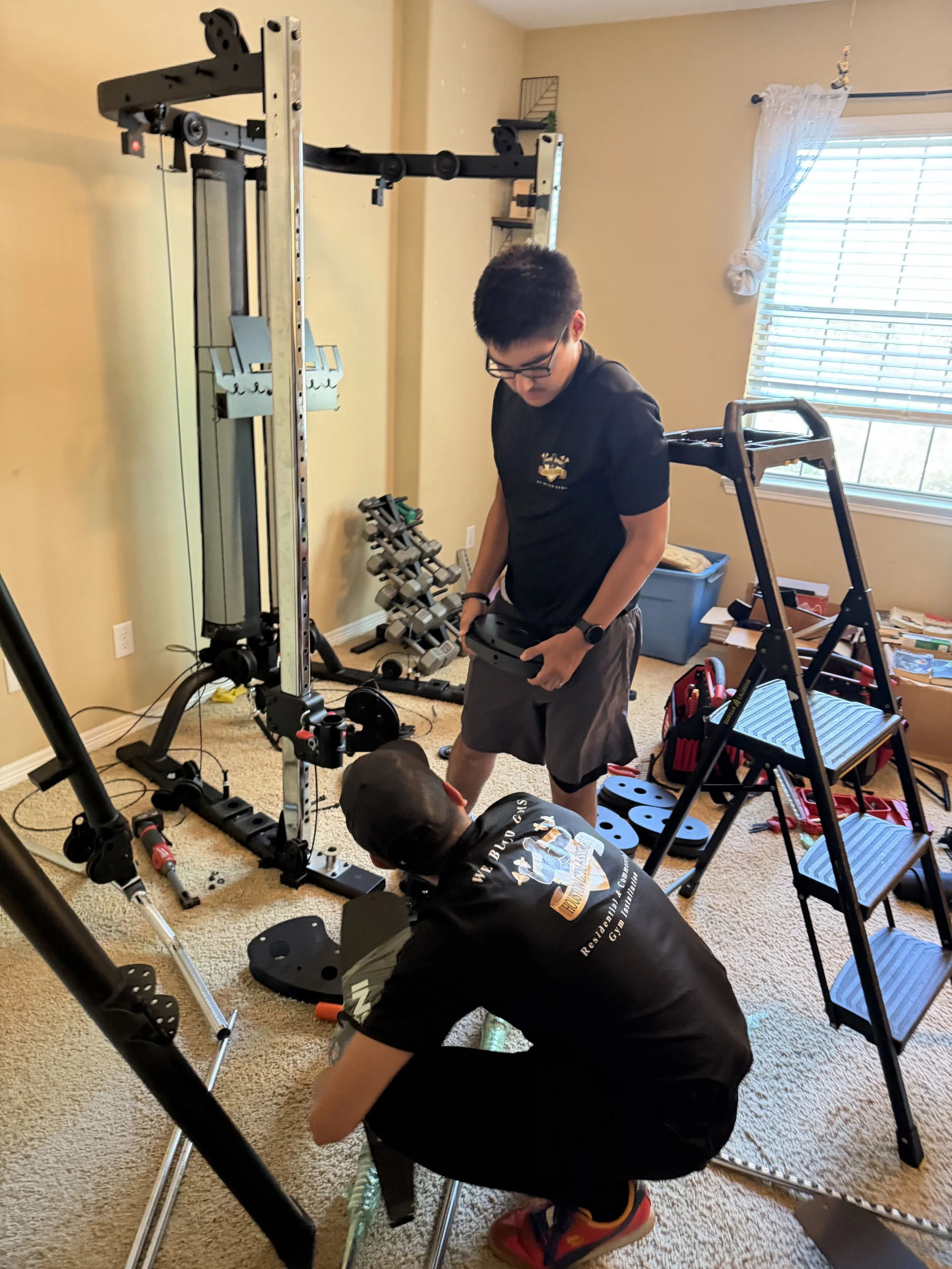
Once we had a plan for the Inspire FT2, the next step was carefully disassembling the machine enough to get it out of the second-floor gym.
With heavy fitness equipment, more disassembly isn’t always better. Every component that comes off has to be protected, transported, tracked, and correctly reinstalled later. Our technicians determine what needs to be removed based on the machine itself and the path it has to travel.
For the FT2, that meant reducing the machine into manageable sections while keeping its eventual reassembly in mind. Hardware and components removed during the process stayed organized with the equipment so they would be there when we needed them at the new home.
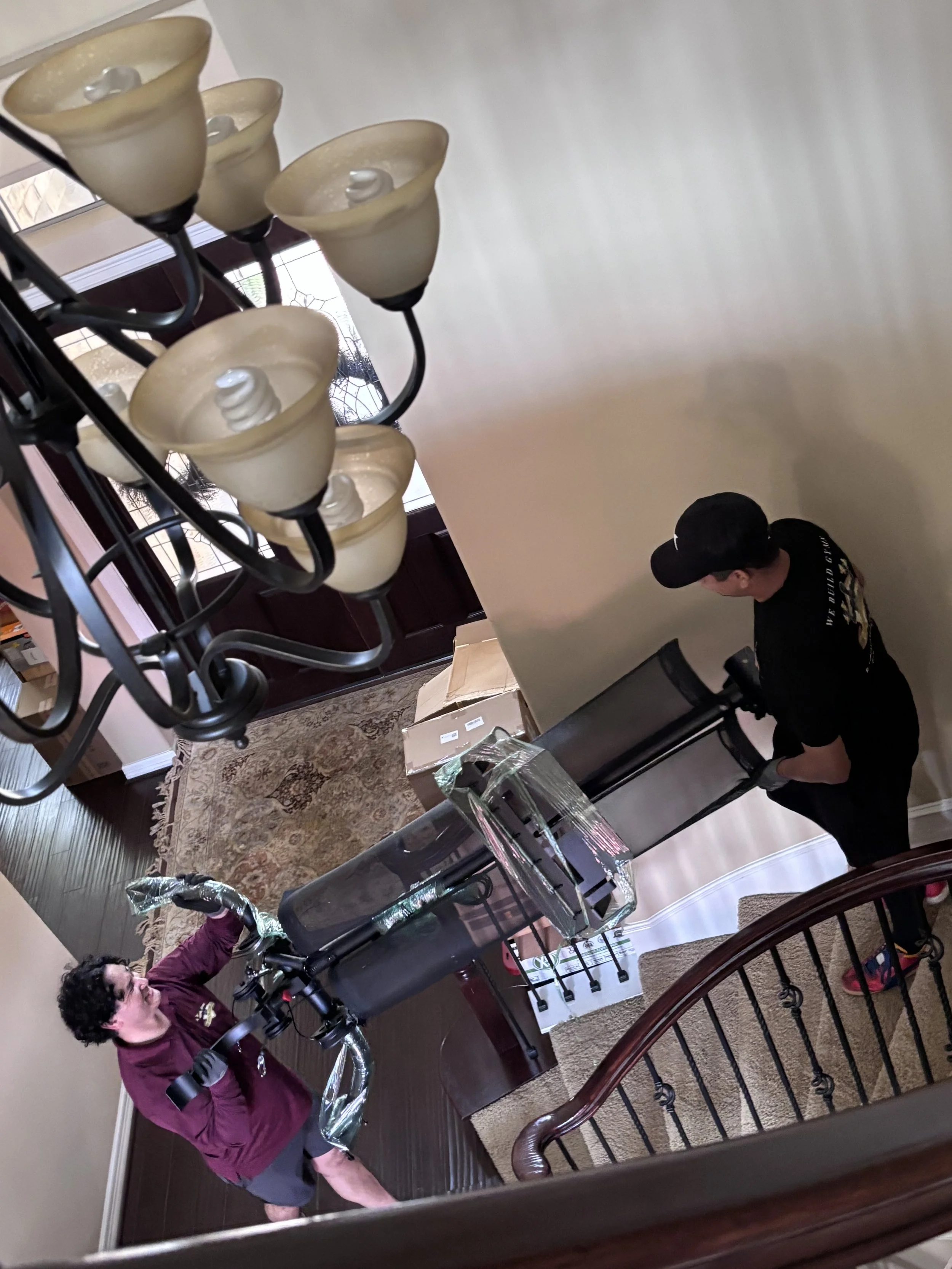
The staircase was one of the most important parts of the move. Large fitness equipment can be heavy, awkward, and difficult to maneuver through residential stairs and landings, even after partial disassembly. Our crew had to control each section of the FT2 while navigating the turns and clearances of the home.
Just as importantly, we were thinking about the house around us. Moving a heavy functional trainer successfully doesn’t mean much if a wall, railing, floor, or piece of equipment gets damaged along the way.
That’s why protecting the home isn’t something we view as separate from fitness equipment moving. It’s part of doing the move correctly.
Protecting Your Home and Fitness Equipment During a Move
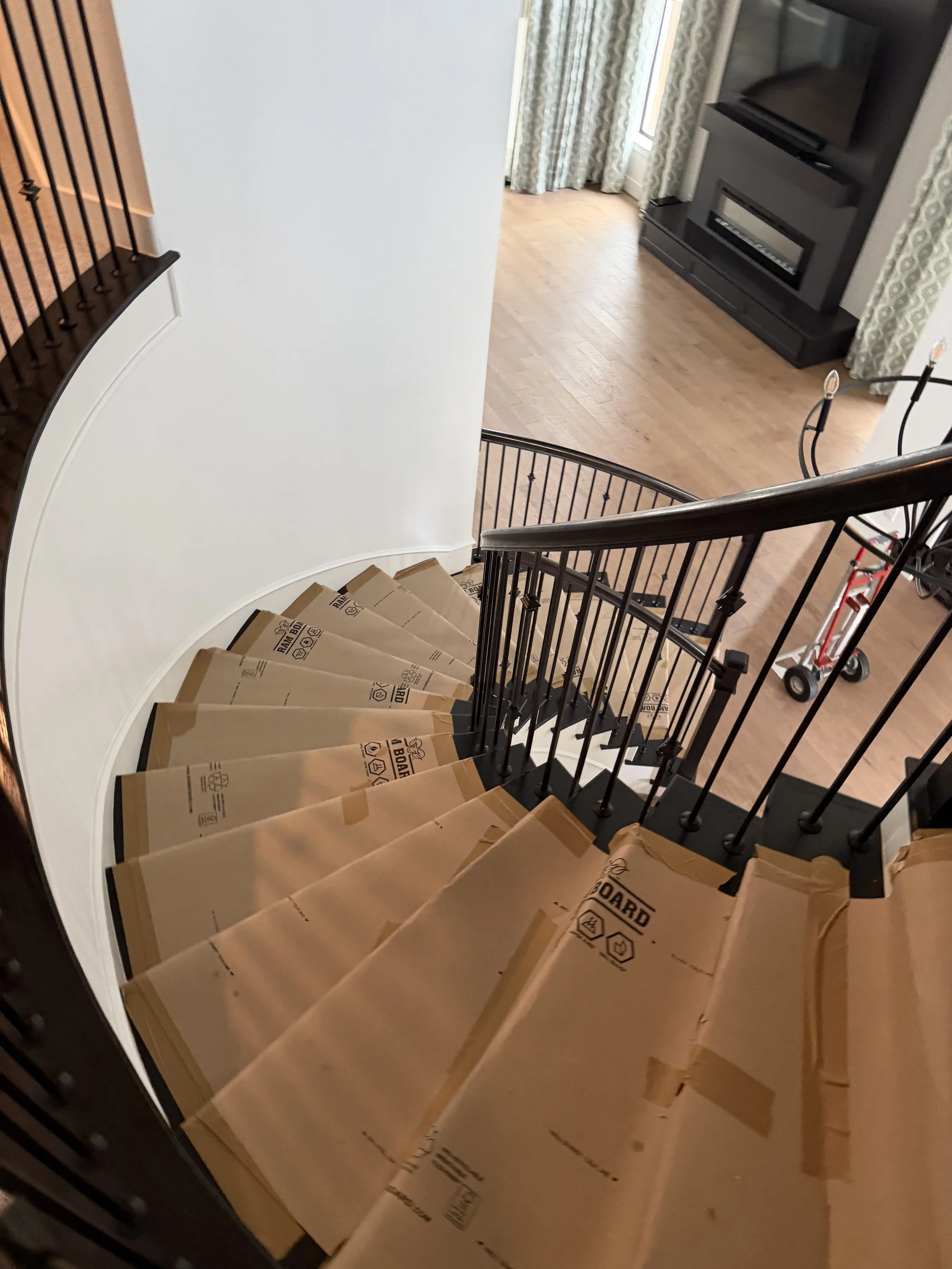
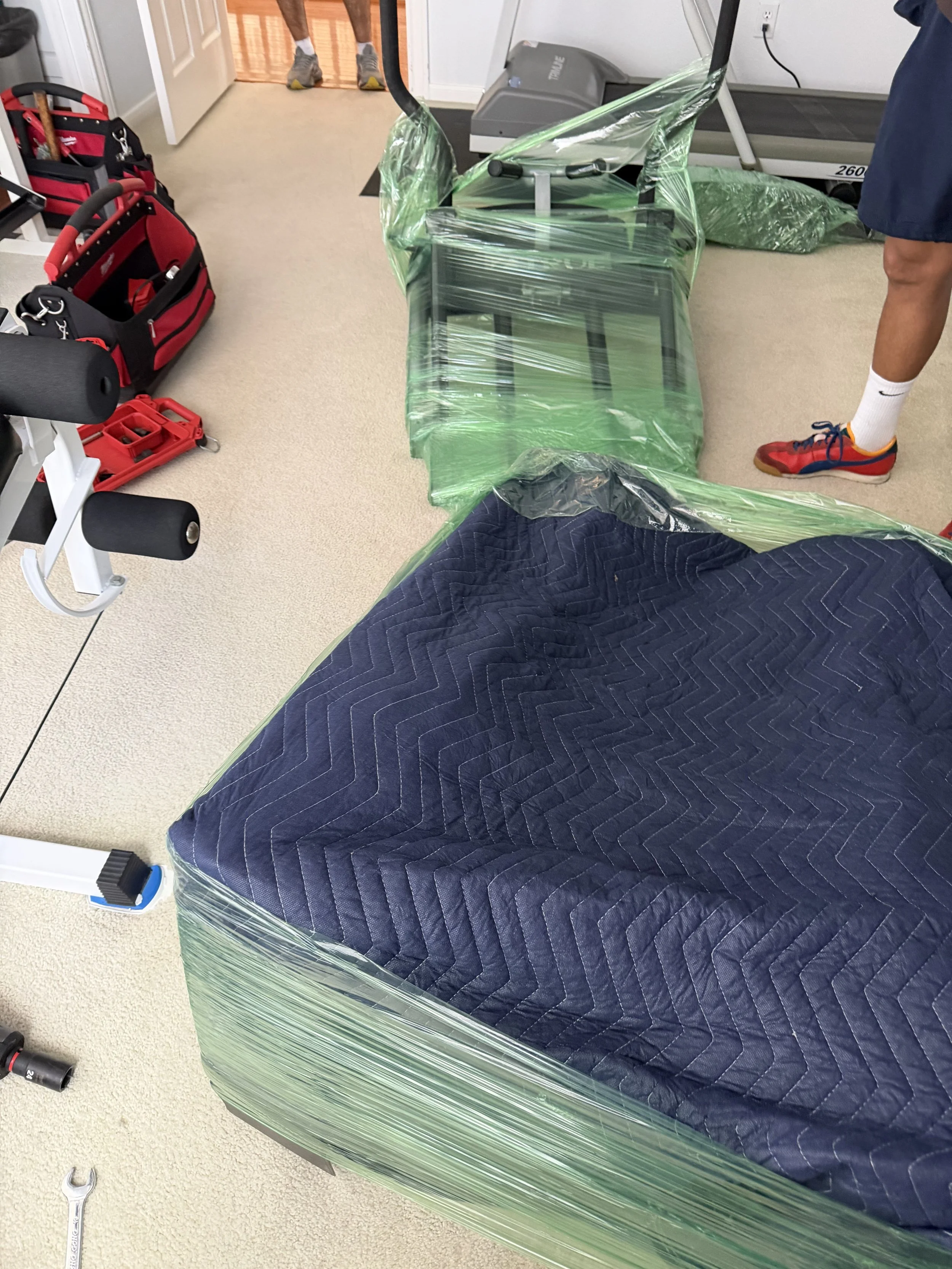
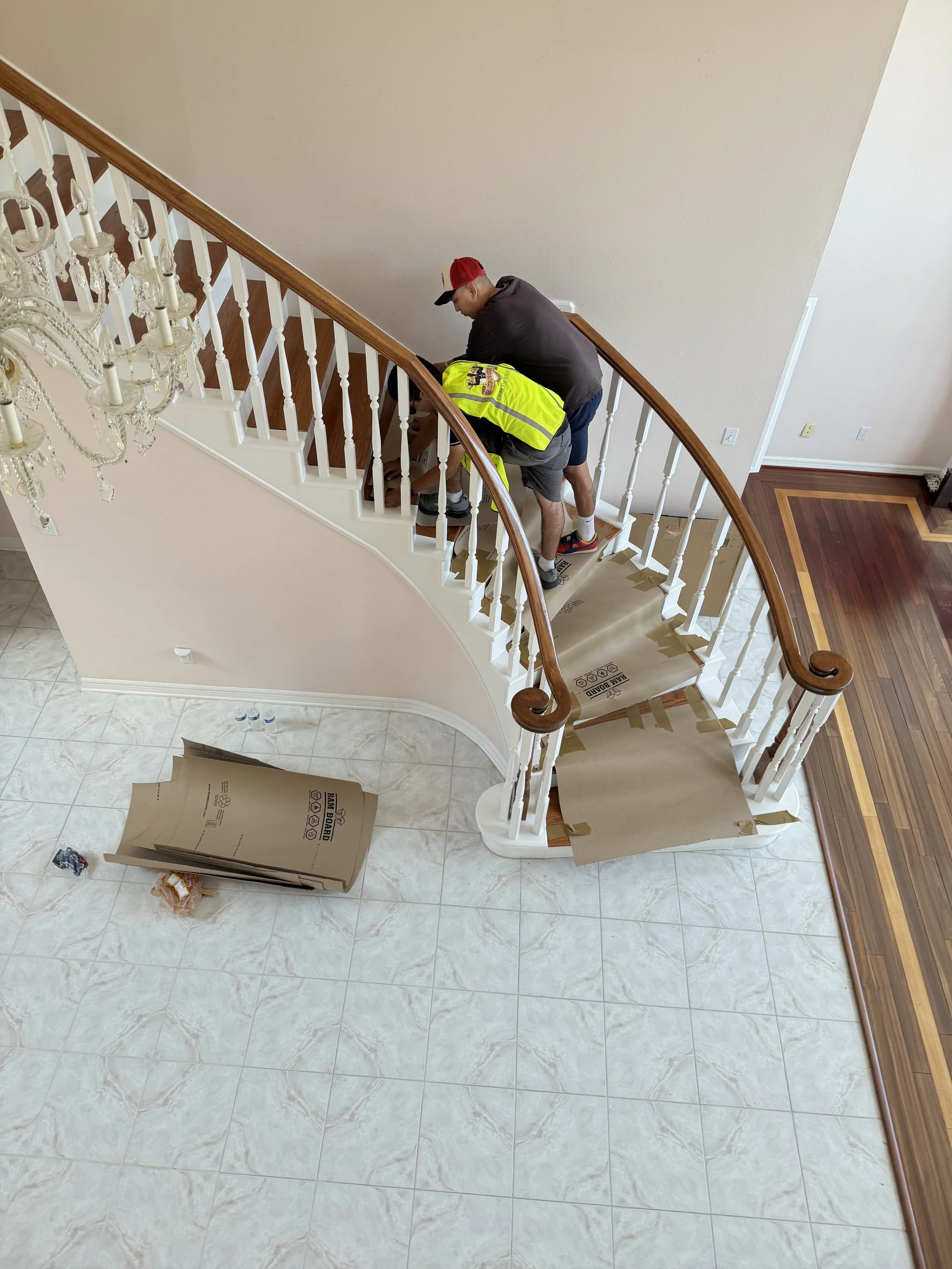
Moving heavy fitness equipment safely involves protecting more than the equipment itself. Floors, stairs, walls, railings, doorways, and tight corners all become part of the moving path, and our technicians are conscious of those surroundings throughout the relocation.
For the Inspire FT2 move, that meant carefully controlling each section of the machine as it traveled from the second-floor gym and through the home. Once components were ready for transportation, we protected the equipment with moving blankets, stretch wrap, and other materials as appropriate before loading and securing it for the trip from Katy to Houston.
At Houston Gym Assembly, standard packing and protective materials needed to safely perform a fitness equipment move are part of our service. We don’t charge separately for ordinary stretch wrap or the reasonable materials our crew uses to protect the home during the relocation. If we need them to do the job correctly, we consider them part of the job.
The same philosophy applies at the new home. Our responsibility isn’t simply to protect the machine while it’s on the truck. We’re thinking about the customer’s property from the moment disassembly begins at the pickup location until the equipment is positioned and reassembled at its destination.
After all, successfully moving an expensive piece of gym equipment while damaging a hardwood floor, staircase, wall, or doorway wouldn’t be a successful move in our eyes.
Protecting the equipment and respecting the home around it go hand in hand. That’s part of what homeowners should expect when hiring professional fitness equipment movers.
Loading and Securing Fitness Equipment for Transportation
Once the Inspire FT2 was safely out of the home, the next part of the relocation was preparing each section for transportation from Katy to Houston.
Disassembling a machine correctly only helps if those components are also handled correctly during the move. Fitness equipment can include heavy steel frames alongside more vulnerable parts such as plastic covers, consoles, cables, pulleys, weight-stack components, and adjustment mechanisms. Each piece needs to be loaded with its construction and weight in mind.
Our technicians use moving blankets, stretch wrap, straps, and other protective materials as appropriate to keep equipment protected and secured during transportation. Components are positioned so they aren’t unnecessarily rubbing against one another, shifting during transit, or placing pressure on more vulnerable parts of the machine.
Organization matters here, too. Hardware and components removed during disassembly remain with the project rather than becoming mixed in with the customer’s household belongings. When we arrive at the destination, everything needed for reassembly should arrive with us.
For a start-to-finish gym equipment relocation, transportation isn’t a separate step handed off to another company. Houston Gym Assembly handles the equipment from the original home, through loading and transportation, and into the new space where our technicians will reassemble it.
The Inspire FT2 arrived in Houston with the same team still responsible for what came next: putting the machine back together and returning it to service.
Fitness Equipment Reassembly Is Part of the Move
Once the Inspire FT2 arrived at the new home in Houston, our job wasn’t finished simply because the equipment had reached its destination. The next step was reassembling the machine and returning it to operating condition.
Because our technicians had handled the original disassembly, there was no guesswork about how the FT2 had been taken apart. We knew which components had been removed, where the hardware belonged, how the cables had been routed, and what needed to happen to rebuild the machine in its new location.
Reassembly is also an opportunity for our technicians to take a closer look at the equipment. Depending on the machine, we’re working directly with cables, pulleys, guide rods, hardware, weight stacks, and other moving components. If guide rods need lubrication, we can address that while the machine is being reassembled. If we notice something worn, loose, damaged, or otherwise worth the customer’s attention, we let them know.
Our technicians also carry a selection of commonly needed bolts, hardware, pulleys, and other fitness equipment parts. When we encounter a minor issue that can reasonably be addressed during the relocation with something we have available, we may be able to take care of it while we’re already there instead of automatically leaving the customer with another service call to schedule.
Once reassembly is complete, we check the equipment’s operation as appropriate for the machine and the work performed. Our goal is to leave the equipment operating as it did before we touched it — and when there are small things we can reasonably improve along the way, we do.
For us, that’s an important part of professional fitness equipment moving. Getting a machine into the correct room isn’t enough if the customer can’t use it when we’re finished.
The Inspire FT2 was successfully reassembled in the new home, completing its relocation from the second-floor gym in Katy to its new first-floor location in Houston. From disassembly and home protection to transportation, reassembly, and the final operational check, the same company remained responsible for the equipment from start to finish.
When “Moved” Doesn’t Always Mean “Move Complete”
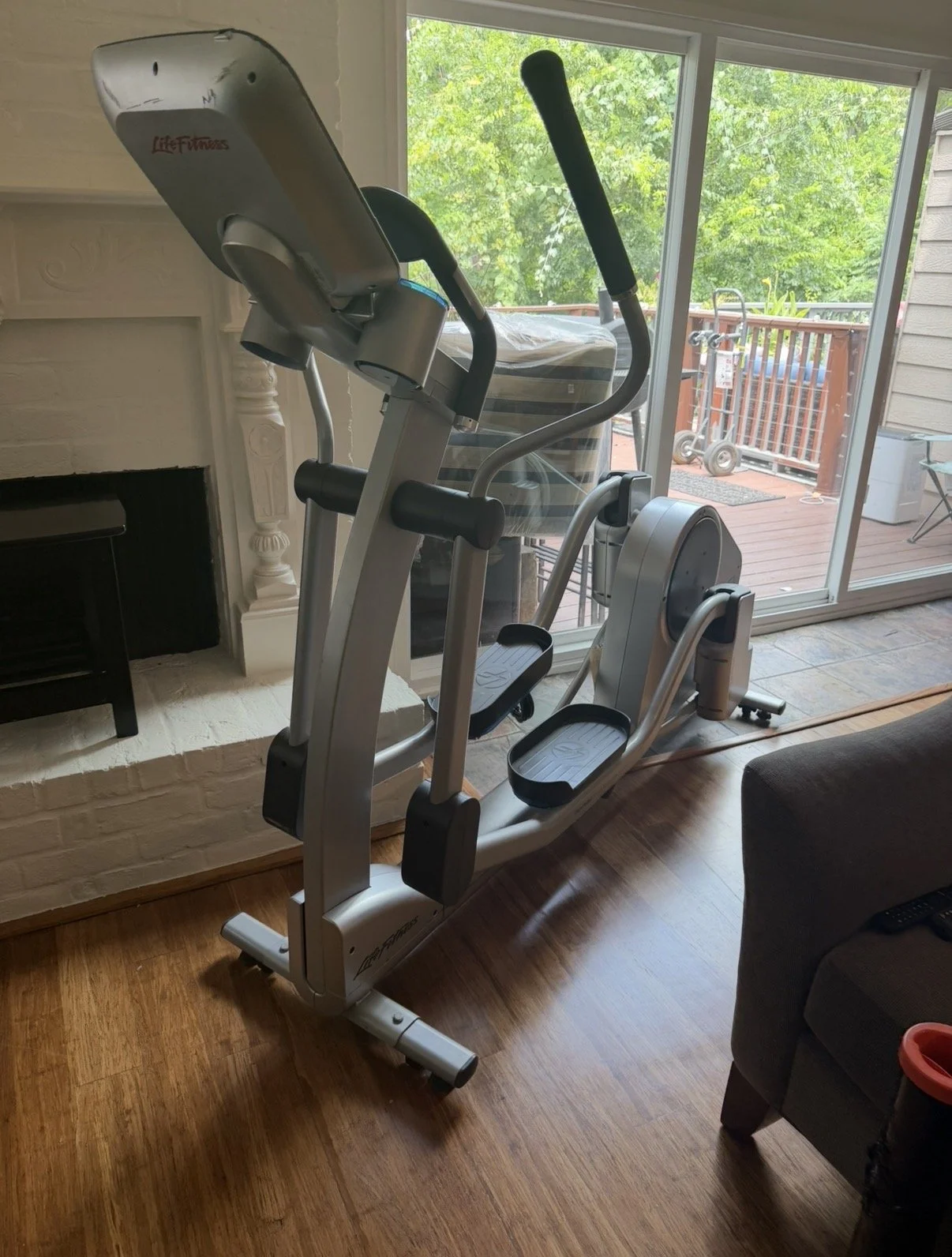
A Life Fitness elliptical that was moved to the customer’s new home but left on the first floor because it could not be moved upstairs fully assembled. Houston Gym Assembly was later hired to disassemble the elliptical, move it upstairs, and reassemble it in the home gym.
Not every company that moves fitness equipment provides the same type of service. That’s why it’s important to understand exactly what is included before hiring movers for a treadmill, elliptical, functional trainer, or other piece of gym equipment.
Traditional moving companies specialize in moving household belongings from one location to another, and many will move fitness equipment as part of a larger household move. The difference often becomes apparent when the equipment requires specialized disassembly or reassembly to reach its final location.
We’ve been called to help homeowners on both sides of that situation.
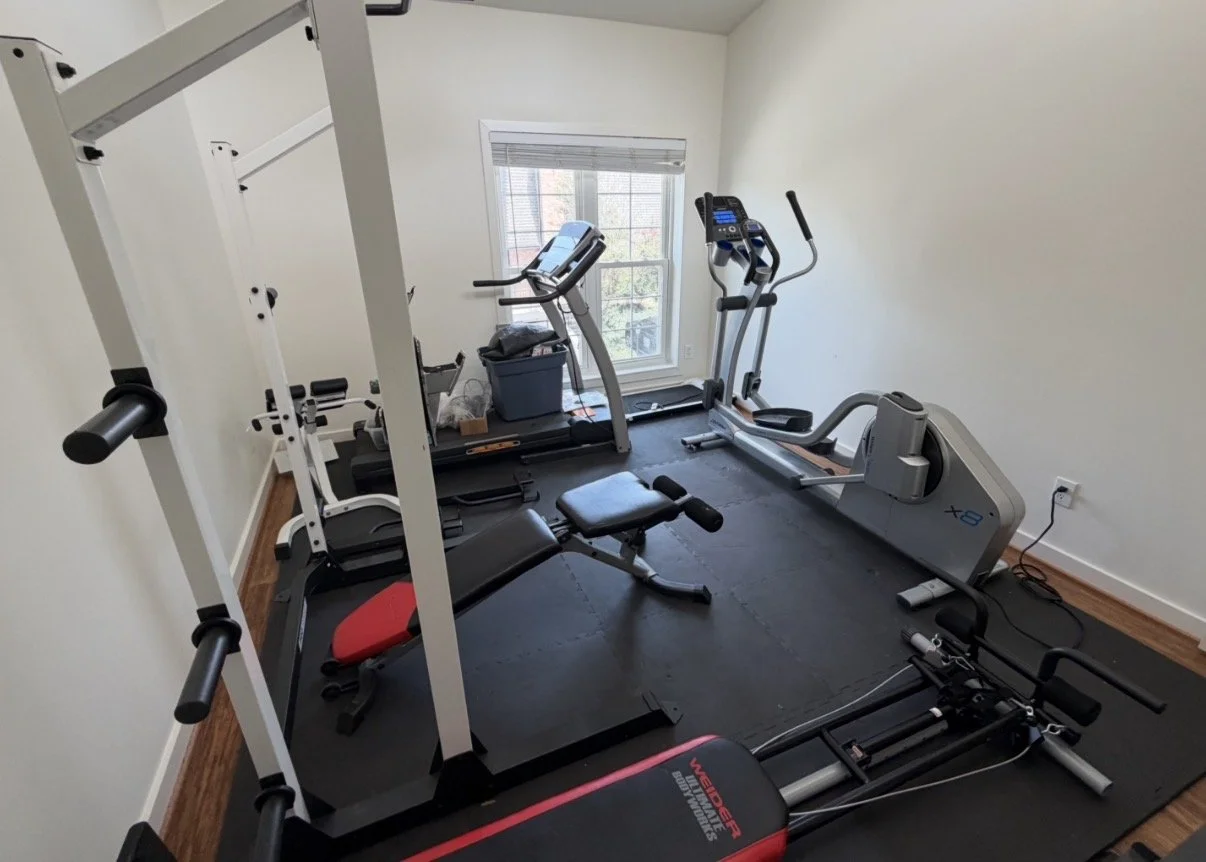
In one Houston-area move, a Life Fitness elliptical had been successfully transported to the customer’s new home, but the movers were unable to get the fully assembled machine upstairs into the home gym. The elliptical had reached the correct address, but it hadn’t reached its final destination.
Houston Gym Assembly was called afterward. Our technicians disassembled the elliptical, moved the appropriate sections upstairs, and reassembled the machine inside the customer’s gym so it could be used where the homeowner intended.
We’ve encountered the opposite situation as well.
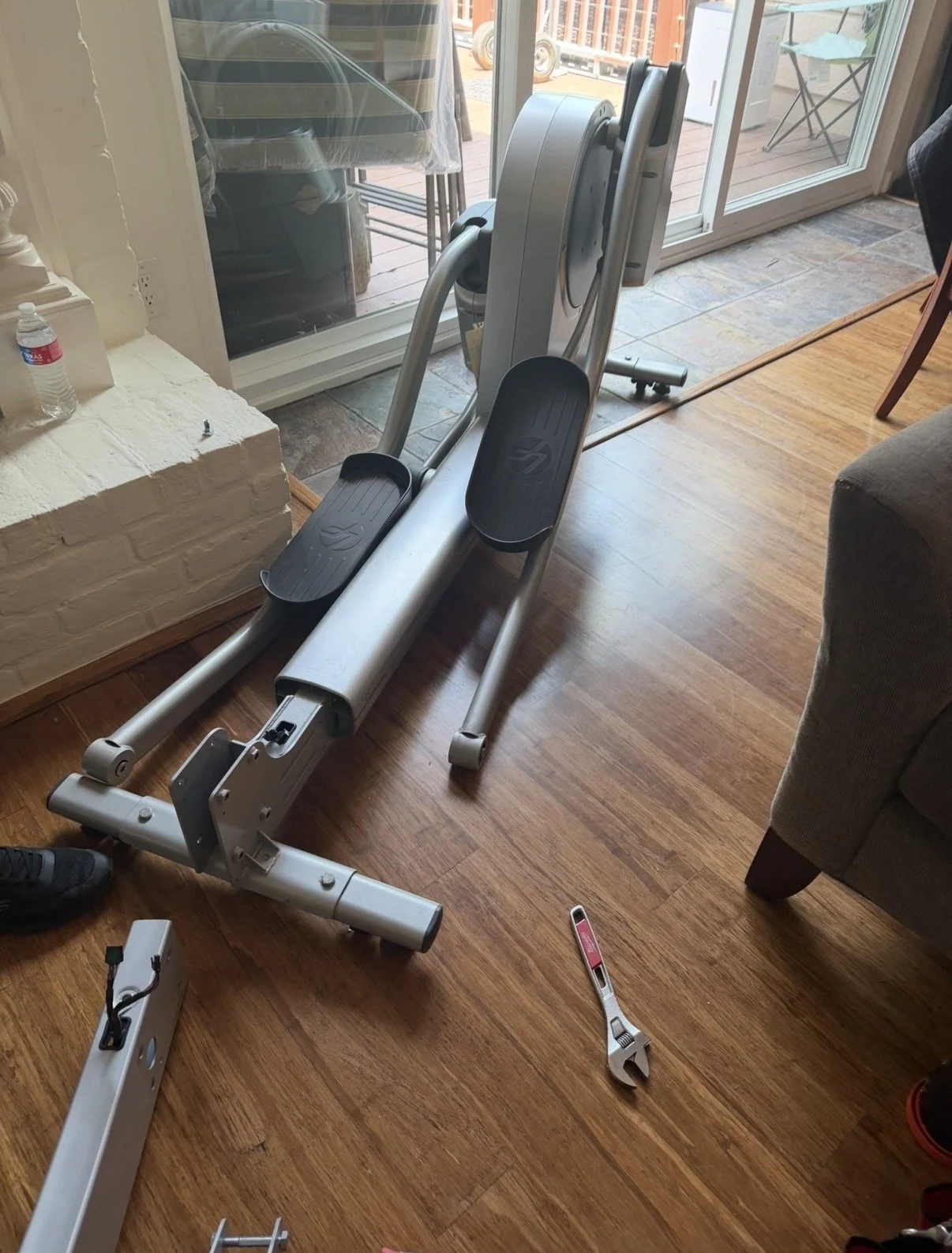
On another project, a moving company disassembled a Life Fitness elliptical so it could be transported upstairs. The movers successfully got the equipment into the correct room, but reassembly wasn’t part of their moving service. We were contacted afterward to finish the job.

A Life Fitness elliptical left disassembled in the customer’s upstairs home gym after being moved by a moving company. The equipment was partially wrapped in moving blankets, but reassembly was not included, leaving the customer with fitness equipment they could not use.
Our technicians substantially reassembled the elliptical but eventually discovered that required components were not with the machine. The homeowner believed the missing pieces had been packed somewhere among the household moving boxes but wasn’t sure where.
Without those components, we couldn’t responsibly complete the reassembly that day. The missing pieces would need to be located and another visit scheduled before the equipment could be completely returned to service.

Life Fitness elliptical after Houston Gym Assembly reassembled the equipment in the customer’s upstairs home gym. Because another moving company originally disassembled and transported the elliptical, several original parts could not be located during our service visit, preventing us from completing the reassembly.
Neither situation necessarily means the original movers did something wrong. They may have completed exactly the moving service they were hired to provide.
But from the homeowner’s perspective, there was still a problem: the fitness equipment couldn’t be used.
These experiences are one reason we encourage homeowners to look beyond whether a company simply says it moves gym equipment. Ask who will handle the disassembly if the machine doesn’t fit through a doorway or staircase. Ask whether reassembly is included. Ask who keeps track of the machine-specific hardware and components. And ask whether the equipment will be checked for proper operation before the crew leaves.
When Houston Gym Assembly handles a complete fitness equipment relocation, those aren’t separate jobs being handed from one provider to another. Disassembly, moving, transportation, reassembly, and the final operational check are all part of the same process.
That’s the difference between getting your fitness equipment moved and getting your fitness equipment move completed.
What to Ask Before Hiring Fitness Equipment Movers
If you’re comparing fitness equipment movers in Houston, don’t base the decision only on whether a company is willing to transport the machine. Before hiring anyone, make sure you understand what happens before, during, and after transportation.
Start by asking whether disassembly and reassembly are included. Large treadmills, ellipticals, functional trainers, Smith machines, and other heavy gym equipment may fit comfortably inside their current room but require significant disassembly to clear a doorway, staircase, hallway, or tight turn during the move.
Ask who will perform that disassembly and, just as importantly, who will put the equipment back together. Having the same company responsible for both sides of the process creates continuity. The technicians performing the reassembly know how the machine was taken apart, which components were removed, and where the machine-specific hardware belongs.
You should also ask how the fitness equipment will be protected and secured during transportation and what precautions will be taken inside your home. Moving blankets, stretch wrap, floor protection, careful planning around stairs and doorways, and proper securement during transportation all help protect both the equipment and the property around it.
What Happens After the Equipment Is Reassembled?
This may be one of the most important questions to ask. Does the technician consider the job finished when the last bolt is installed, or will they take the time to check the machine’s operation before leaving?
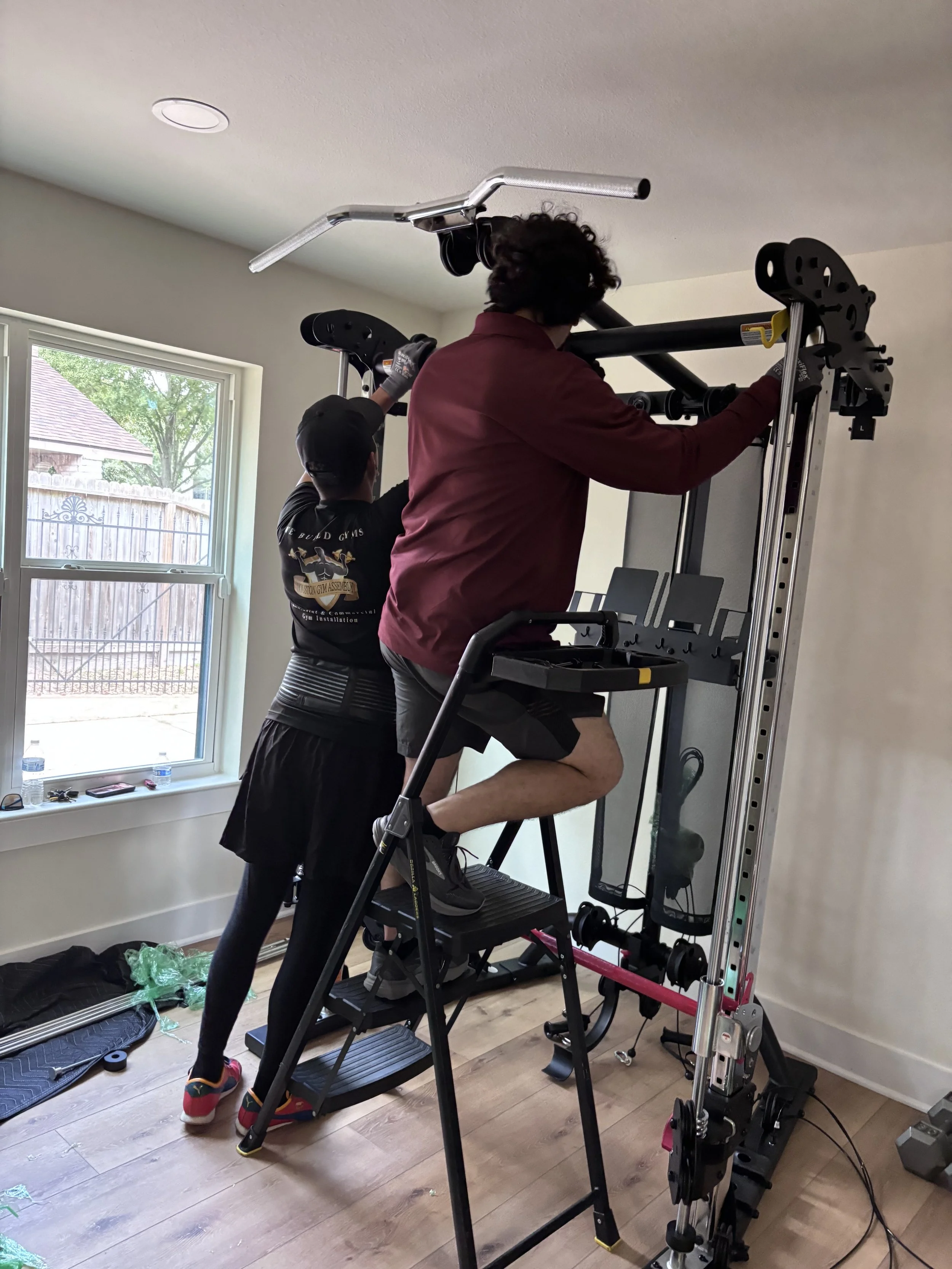
A piece of fitness equipment can look completely assembled and still have something that needs attention. A cable may not be tracking correctly, a pulley may not be moving as expected, guide rods may need lubrication, hardware may need adjustment, or the machine may simply operate differently than it did before the move.
At Houston Gym Assembly, our technicians don’t want to discover those things after we’ve already left. Once the equipment is reassembled, we check its operation as appropriate for the machine and the work performed. If something doesn’t look, sound, or feel right, we want to investigate it while we’re still there.
That same attention applies to issues that may have existed before the move. If we notice something worn, damaged, loose, or otherwise worth the customer’s attention, we’ll point it out. Our technicians also carry commonly needed fitness equipment hardware, bolts, pulleys, and supplies. When a minor issue can reasonably be addressed with something we have available, we may be able to take care of it during the same visit rather than leaving the customer to schedule a separate fitness equipment service call.
For us, reassembly isn’t the finish line. We’re not comfortable calling a fitness equipment relocation complete simply because the machine looks like it’s back together. We want to be comfortable with how we’re leaving the equipment before we walk out the door.
That’s an important distinction when choosing professional gym equipment movers. The goal isn’t simply to transport something heavy from one address to another. The goal is to relocate a functioning piece of fitness equipment, reassemble it correctly, and leave the customer with equipment they can actually use again.
Getting It There Is Only Half the Job
When you’re hiring fitness equipment movers, getting the machine from one address to another is obviously important. But for specialized gym equipment, transportation alone doesn’t necessarily complete the relocation.
The Inspire FT2 move from Katy to Houston is a good example of what we believe a complete fitness equipment move should look like. Our technicians handled the machine from the moment disassembly began at the original second-floor gym through protection, moving, transportation, reassembly, and the final operational check at the new home.
There was no point during the relocation when responsibility for the equipment changed hands.
That’s the standard we want our customers to expect from Houston Gym Assembly. Whether we’re moving a treadmill, elliptical, functional trainer, Smith machine, or an entire home gym, our responsibility goes beyond getting something heavy onto a truck.
We want the equipment to arrive where you actually want it, be properly reassembled, and be ready for you to use again. And if we notice something along the way that deserves your attention, we’re going to tell you.
Your fitness equipment can represent a significant investment, and your home deserves the same level of care. Choosing the right fitness equipment moving company means trusting someone with both.
For us, the move isn’t complete just because the equipment arrived.
It’s complete when we’ve finished our work, checked the equipment, and we’re comfortable with how we’re leaving it.

Completed Inspire Fitness FT2 after Houston Gym Assembly handled the equipment relocation from start to finish. The functional trainer was reassembled, lubricated, tested for proper operation, and the work area was cleaned before our crew completed the job.
Planning a Fitness Equipment Relocation in Houston?
Whether you’re moving a single piece of fitness equipment or relocating an entire home gym, Houston Gym Assembly can handle the project from start to finish.
Our fitness equipment technicians provide professional disassembly, moving, transportation, reassembly, and installation throughout the Houston area. From treadmills and ellipticals to functional trainers, Smith machines, strength equipment, and complete home gyms, we handle the equipment ourselves rather than referring your project to a third-party provider.
If you’re planning a move and want one company responsible for your fitness equipment from the first bolt removed through final reassembly and operational checks, we’d be happy to learn more about your project.

Bryan Mendes — Owner, Houston Gym Assembly
Bryan Mendes is the owner of Houston Gym Assembly and specializes in professional fitness equipment assembly, disassembly, and relocation throughout the Houston area. His team works with treadmills, ellipticals, functional trainers, Smith machines, power racks, and complete home and commercial gym setups.